There Is a Living Cockroach With an AI Backpack Working for NATO Right Now
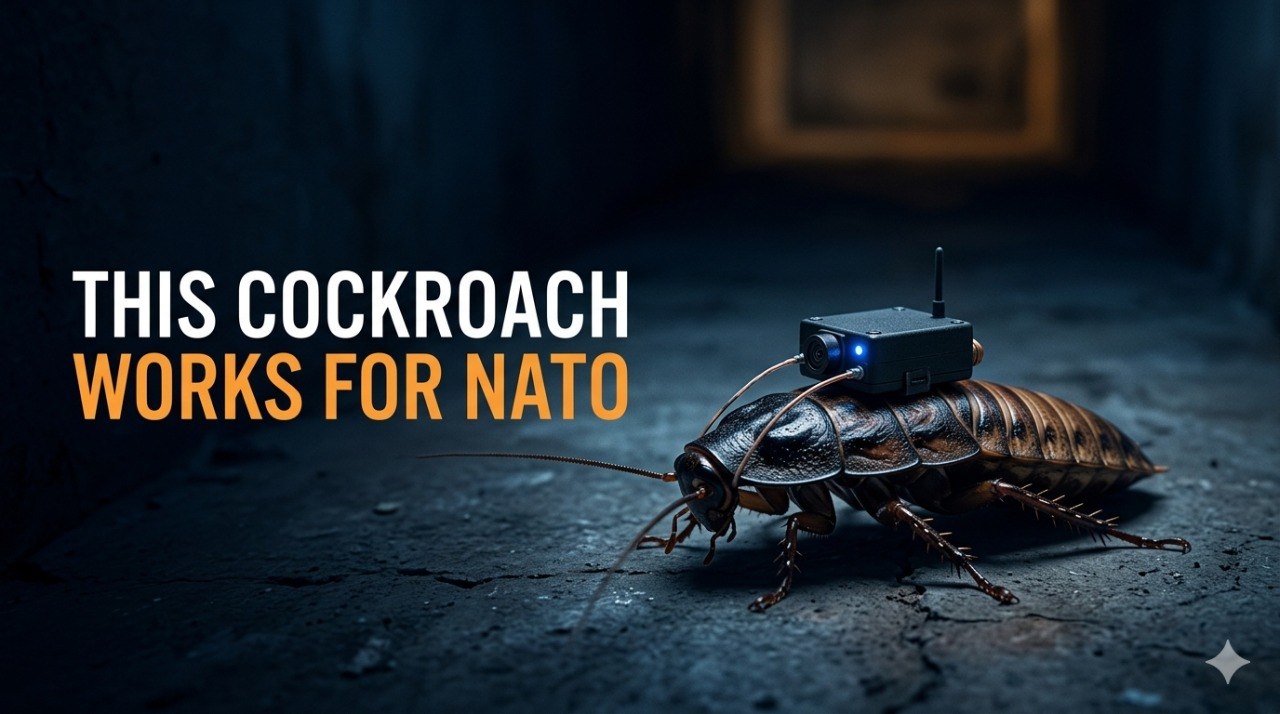
In February 2026, the chief executive of a German defence startup posted a short message that read, in part, one year ago this did not exist. Today we deploy programmable cyborg insect swarms, field tested and operational with paying NATO customers.
The company is called SWARM Biotactics. It is based in Kassel, Germany. Its primary product is a living Madagascar hissing cockroach fitted with a miniature electronic backpack, steered by electrical impulses through a neural interface, carrying its own sensors and edge AI processing. The paying customers include the German Army, the Bundeswehr. The systems have been field validated in both Europe and the United States.
This is not a concept. It is not a laboratory demonstration. It is a fielded capability that you have almost certainly never heard of.
Source: Defence Blog on the SWARM Biotactics deployment
What It Actually Is
Start with the insect. SWARM Biotactics uses the Madagascar hissing cockroach for a set of very practical reasons. It is large enough to carry electronic components. It can survive for weeks without food. It tolerates low-oxygen environments, heat, radiation, and chemical exposure that would disable a conventional machine. It produces almost no acoustic or thermal signature.
On the insect's back sits an ultra-light modular backpack. According to the company, this backpack contains a bioelectronic neural interface, onboard sensors including a camera, edge artificial intelligence processing, and a secure short-range communications link. The neural interface delivers low-voltage electrical impulses that influence the insect's movement. An operator can steer a single cockroach, or allow a group of them to operate autonomously as a coordinated swarm.
The backpack is the part that connects this story to one we have told before. The edge AI on that backpack is exactly the kind of small, cheap, on-device intelligence described in an earlier Bidfoil piece. The chip does not phone home to a datacentre. It processes what the cockroach sees, on the cockroach, in real time.
Why a Cockroach and Not a Drone
The obvious question is why anyone would use a living insect when drones exist. The answer is the part of modern warfare that drones cannot reach.
SWARM Biotactics describes the intended mission not as wide-area surveillance, but as the last 50 metres. The cluttered, confined, GPS-denied micro-terrain where a drone cannot fly and a soldier cannot safely go. Tunnels. Collapsed buildings. Rubble. The inside of a structure that may or may not hold hostiles.
A drone in such a space is loud, large, and quickly disabled. A scout team is exposed to whatever waits inside. A cockroach the size of a thumb, carrying a camera and a radio, crawling under a door and into a room, is none of those things. The company's own framing is blunt. Conventional systems fail where control is needed most. Denied zones, collapsed infrastructure, politically complex terrain.
The founder, Stefan Wilhelm, put the philosophy this way. The company is not building a better drone. It is building a different scaling law for physical intelligence, one where capability compounds through biology rather than engineering complexity. The cockroaches are bred, not manufactured.
What This Means for India
India has exactly the kind of terrain where last 50 metres reconnaissance matters most.
Tunnels along contested borders. Dense urban environments in counter-terrorism operations. Cave and bunker complexes. Collapsed structures after a disaster. These are the places where a soldier is most exposed and a drone is least useful. The bio-hybrid approach is a direct answer to a problem the Indian armed forces understand well.
Whether India is researching its own bio-hybrid micro-reconnaissance is a legitimate open question, and not one this publication can or should answer with specifics. What can be said is that the underlying science is published, the enabling technologies are the same edge AI and miniature sensors that India already works with, and the cost of entry is measured in tens of millions, not billions. This is not a capability reserved for superpowers. It is a capability reserved for whoever decides to build it.
The Uncomfortable Part
There is something genuinely unsettling about a living animal turned into a steerable sensor platform, and it is worth sitting with rather than skipping past.
For two decades this lived safely in the category of strange research. A funded curiosity. Something that might one day matter. In February 2026 it quietly crossed into the category of things that armies actually buy and use. The line between the engineered and the living, between the machine and the animal, is now a line that a defence procurement officer can place a purchase order across.
The cockroach in the tunnel does not know it is at war. It is following the small electrical nudges to its antennae, carrying a backpack it cannot feel, sending back a picture it cannot see. Somewhere, twenty years from now, this may be as ordinary as a quadcopter is today. The strangest part of the story is not that it exists. It is how quickly it stopped being strange.