AI Is Now More Expensive Than the Employees It Was Supposed to Replace. Lessons for Bidfoil Readers
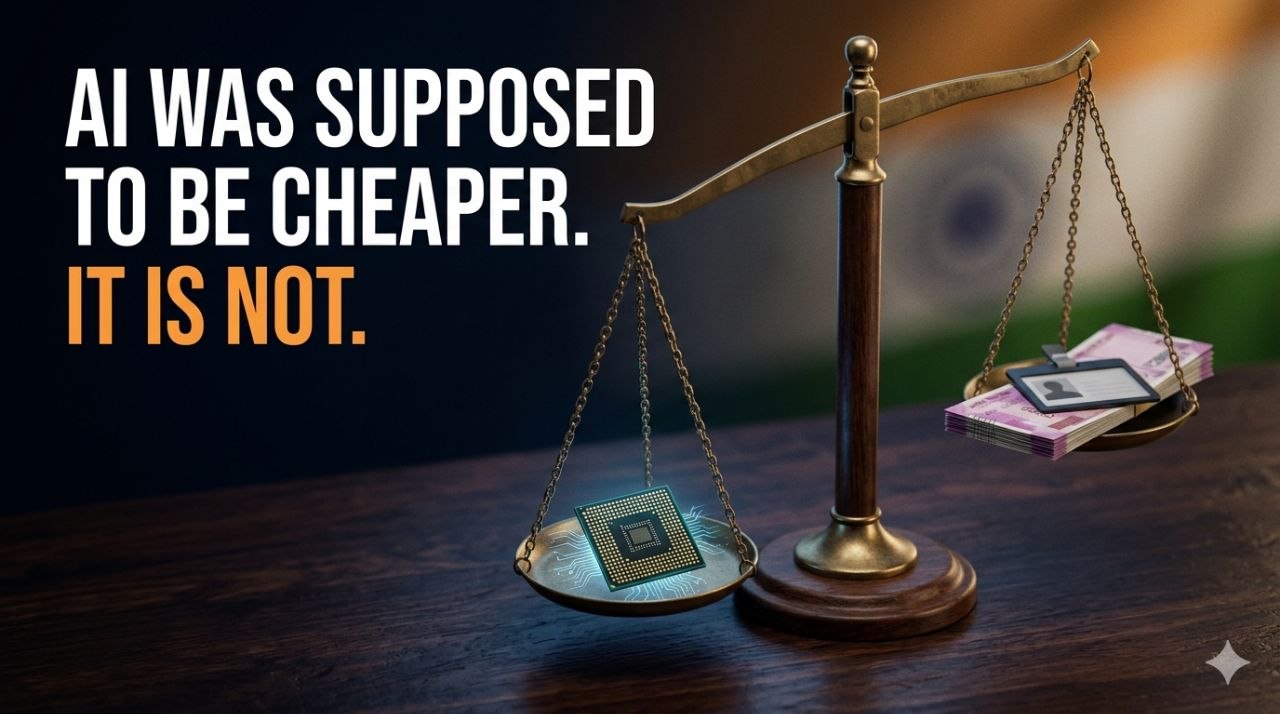
In July 2025, Microsoft's Chief Commercial Officer Judson Althoff told staff in an internal presentation that AI tools had saved the company over five hundred million US dollars in its call centre operations alone in one year. That figure works out to roughly Rs 4,150 crore.
In the same year, Microsoft laid off approximately 15,000 employees across three rounds. The company posted Rs 2.16 lakh crore in quarterly profit, hit a market value of Rs 31 lakh crore, and announced an Rs 6.64 lakh crore AI infrastructure investment plan for the year.
Both numbers are real. Both happened at the same company in the same year. The math behind them, and the gap between them, carries five lessons every Bidfoil reader should hold in mind before the next AI announcement arrives.
Source: TechCrunch on the Althoff statement
Lesson One. Cheap AI Was a Subsidy, Not a Price
The Rs 1,700 per month ChatGPT Plus subscription exists because investors are paying for the compute that makes it possible.
OpenAI is projected to lose around Rs 1.16 lakh crore in 2026 alone. Its cumulative losses through 2029 are estimated at Rs 9.5 lakh crore. Anthropic burned approximately Rs 46,000 crore in 2025. Both companies sell most of their subscriptions below the cost of providing them.
Pricing changes are now happening every quarter. Cursor publicly apologised after switching from fixed-quota to credit-based billing in 2025. Anthropic blocked third-party tools from using subscription quotas in April 2026. GitHub Copilot is moving to fully usage-based billing in June 2026.
The lesson for a Bidfoil reader is straightforward. Do not plan a personal or professional workflow around prices that cannot last. Build on tools you can afford long-term, including offline tools where possible. The current AI price tag is a transition, not a destination.
Lesson Two. The Indian Salary Math Is Different
An American mid-level engineer costs the employer between Rs 1 crore and Rs 2 crore per year fully loaded.
In India, the same role looks different. A fresher software engineer at TCS, Infosys, or Wipro earns Rs 3.5 to 7 lakh per year. A mid-level engineer in Bangalore earns Rs 16 to 28 lakh per year. A senior engineer at a top product company earns Rs 40 to 60 lakh per year. Even at the highest end, an Indian engineer typically costs one-third to one-half of what an American engineer at the equivalent level costs.
This matters because the AI subscription that pays for itself in America by replacing one expensive American engineer may take a year or longer to pay for itself in India.
The lesson for a Bidfoil reader is that the AI-replaces-employee narrative being imported from American business press does not describe the Indian situation accurately. Indian salary structure is currently a strategic asset. The window will close as AI prices rise and Indian salaries continue to climb, but for now the calculation is genuinely different. Reading American AI commentary and applying the same conclusions to Indian institutions is a mistake.
Lesson Three. AI Does Structure, Not Judgement
What Microsoft saved in its call centre was structure. Routine query handling, simple transactions, repetitive answer-generation. What survived the layoffs was judgement work. Unusual situations. Ambiguous cases. Decisions that required reading between the lines.
This pattern is consistent across every documented case of AI-related job displacement. The jobs going first are the ones with the highest ratio of repetition to judgement. The jobs that remain, even at the companies cutting most aggressively, are the ones where judgement is the central act.
The lesson for a Bidfoil reader is that your value at work, especially in defence and government roles, is now even more concentrated in the judgement parts of what you do. The structure parts will increasingly be done by AI. The judgement parts will be done by you. Lean into the judgement. Be the person whose decisions are worth making, not the person whose tasks are worth completing.
Lesson Four. The First Movers Are Not Always the Winners
There is a pattern in the layoff data that almost no one is naming. The companies cutting the deepest in 2025 and 2026 are the ones that deployed AI most aggressively in 2024 and 2025.
They bought first. They deployed widely. They are now discovering, in real time, which AI investments paid back and which did not. Many of the layoffs are not victories for AI. They are corrections of over-deployment.
Meanwhile, companies that waited are now buying selectively, with better information about what works. They are paying lower per-seat prices because the market has matured. They are avoiding the dead-ends and the wasted licences.
The lesson for a Bidfoil reader, especially anyone watching Indian institutional AI procurement, is that being early is not always a strategic advantage. Watching what worked elsewhere, then deploying selectively with patience, may be the smarter posture. This applies to the defence establishment as much as it does to any individual business.
Lesson Five. Sustainment Is the Question Nobody Asks
If American hyperscalers cannot make AI subscriptions profitable, India's sovereign AI ambitions face the same brutal economics.
The IndiaAI Mission has an outlay of Rs 10,000 crore. The Defence Centre of Excellence is funded at Rs 300 crore. Sarvam, BharatGen, Gnani, and the others are building real models. The question that is almost never asked publicly is what it will cost to run all of this at scale for the next fifteen years.
Capability development is the easy part. The bill that comes after is the harder one. An air-gapped defence AI capability, by design, cannot be subsidised by a global user base. Every inference runs on India-controlled compute. Every model update requires India-funded infrastructure.
The lesson for a Bidfoil reader is that when the next sovereign AI procurement is announced, the right question is not whether India can build it. The right question is whether India can afford to run it. That question is the one that will decide whether Indian AI ambitions, civilian and defence, survive the next decade.
One Underlying Truth
Five lessons, one underlying truth.
AI is a tool. Tools have economics. The economics decide whether the tool is useful in the long run or only in the short run.
The reader who understands this will make better decisions than the reader who reacts to the latest announcement, the latest funding round, the latest layoff headline. The companies cutting jobs and the companies hiring will both look correct in different moments. The Bidfoil reader who learns to read past the headlines, to the actual rupee math underneath, is the reader who will be still standing in 2030 doing work that matters.