From Datacentres to Drones. What is Edge AI
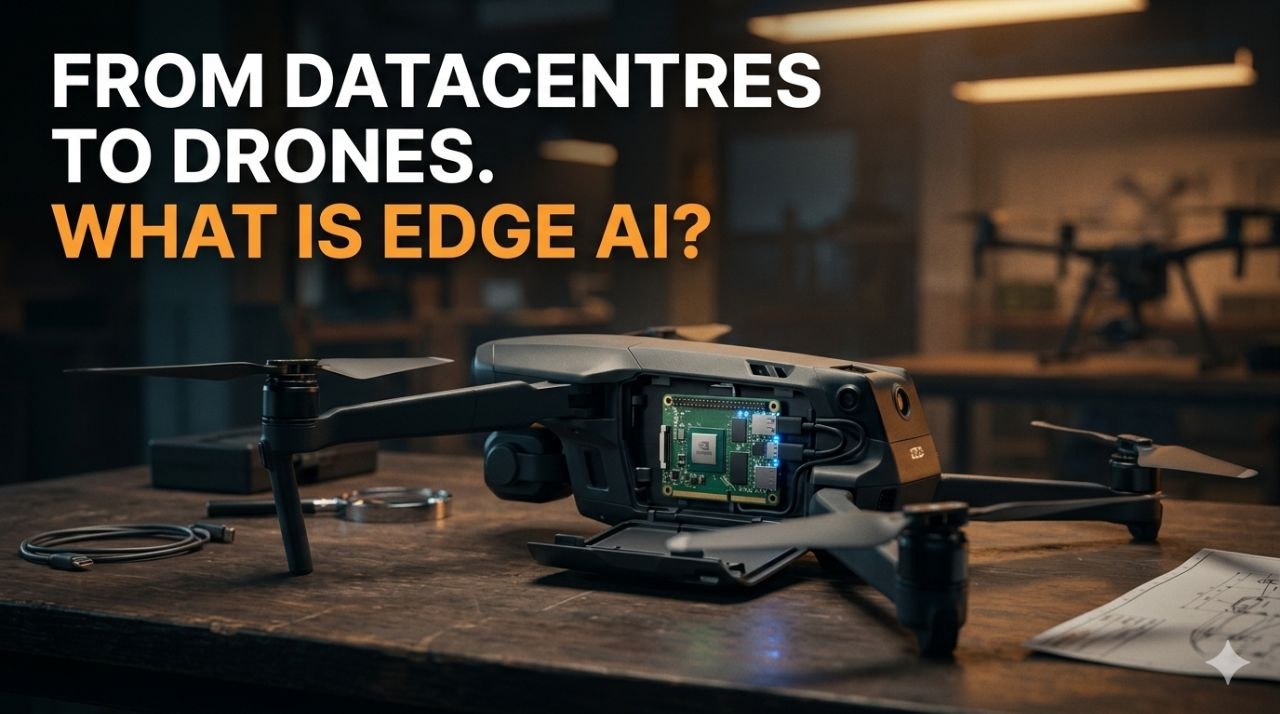
An Nvidia Blackwell GPU in a Texas datacentre is the size of a pizza box, costs more than a Toyota Innova, and draws sixteen hundred watts of electricity. A different kind of AI chip, doing useful work right now, fits inside a matchbox, costs less than a smartphone, and draws less power than a laptop charger.
Both are AI chips. Both run AI models. The difference between them is the entire subject of this article. Call it edge AI: the world of small, cheap, on-device AI hardware that has quietly become the largest single category of AI deployment on earth.
This is the AI in your phone, in your camera, in your car, in modern drones, in factory robots, in smart city installations. Most AI in the world today is not happening in a datacentre. It is happening at the edge.
Where Edge AI Already Works
Five places it lives, each running on the same general class of small chip.
One. The phone in your pocket. Live speech-to-text in WhatsApp voice notes. Photo search by what is in the picture. Camera scene recognition. On-device translation. None of these touch the internet on a modern flagship phone. The chip doing this work is called an NPU, short for Neural Processing Unit. Your phone has one.
Two. Industrial inspection. Factory floors worldwide now use edge AI to find defects in real time. A camera mounted next to an assembly line sees the product, identifies the flaw, sounds the alert. The board doing the work costs less than a mid-range mobile phone and does not need a cloud connection.
Three. Smart traffic and city cameras. Many smart-city deployments worldwide, including in Indian cities, use edge AI to count vehicles, detect traffic violations, and read number plates locally. The summary data goes to the control room. The raw video never leaves the camera.
Four. Drones. This is where the defence dimension begins.Modern surveillance and strike drones now carry edge AI chips that can identify objects, track moving targets, navigate around obstacles, and continue functioning when the link to the operator is jammed. In the Russia-Ukraine war, Ukrainian intelligence has documented multiple cases of recovered Russian drones, including the MS001 variant of the Shahed and the V2U strike drone, containing credit-card-sized Nvidia Jetson Orin modules acting as the drone's brain. Ukrainian Major General Vladyslav Klochkov described one such drone as a digital predator that sees, analyses, decides, and strikes, without external commands. The same class of chip is used inside counter-drone systems on the other side of the same war.
Five. Defence vision and sensor fusion. Beyond drones, edge AI is moving onto larger defence platforms for radar interpretation, thermal imaging analysis, and onboard sensor fusion. The US Project Maven programme is the most documented public example. The pattern is consistent across every modern military. AI is moving out of the datacentre and onto the platform itself. Indian defence platforms are increasingly in this conversation as well, though specifics remain appropriately reserved.
Source: Calibre Defence on the Russian V2U drone, Ukrainian GUR War and Sanctions portal via DroneXL
How Small
The Neural Engine inside an Apple iPhone 16 Pro is roughly the size of a one-rupee coin. It runs at 35 TOPS, or 35 trillion AI operations per second. The Qualcomm Snapdragon 8 Elite in flagship Android phones runs at 45 TOPS on a chip smaller than a fingernail.
The Nvidia Jetson Orin Nano, used in drones, robots, and industrial cameras, is roughly the size of a credit card. It runs at 40 to 67 TOPS and draws as little as 7 watts. For comparison, the LED bulb in most Indian living rooms draws 9 watts.
TOPS is the unit. It is to AI chips what horsepower is to engines. To set the scale: an Nvidia Blackwell B200 datacentre chip runs around 5,000 TOPS. A flagship Indian smartphone has roughly one per cent of the AI capability of a Blackwell, in roughly one thousandth of the size, at roughly one ten-thousandth of the cost.
That ratio is why edge AI is interesting.
How Cheap
The numbers in rupees.
A Raspberry Pi 5 with the AI HAT+ accessory: under ten thousand rupees, capable of running small models for object detection or speech recognition.
An Nvidia Jetson Orin Nano, the credit-card chip: ₹18,000 to ₹22,000 from authorised Indian distributors. The 8GB variant with a higher-spec carrier board runs ₹35,000 to ₹45,000.
A flagship smartphone with a modern NPU: ₹50,000 to ₹1,50,000. Most readers already own one.
An entry-level edge AI development board costs less than a mid-range mobile phone. For the price of a single Nvidia Blackwell datacentre chip, you can buy roughly 250 Jetson Orin Nanos. Cost is no longer the barrier to deploying AI capability. The barrier is knowing what to do with it.
Why On-Device Sovereignty Matters
When you ask ChatGPT a question, your words travel to a server in America, get processed there, and travel back. The conversation may be logged, may be used to train future models, and is governed by foreign data protection laws. For most uses this is acceptable. For some it is not.
When an AI model runs on the chip inside your phone, none of that happens. The model is downloaded once. The data you give it never leaves the device. No data broker can sell what was never collected.No foreign government can compel the data because no foreign entity ever holds it.
This is on-device sovereignty. It is not just a privacy benefit. It is a structural property of how the AI runs.
For an Indian reader, the implications cascade. A sensitive document analysed by an on-device model is read only by you. A voice note transcribed on-device is heard only by your phone. The data that does not move cannot be intercepted, harvested, leaked, or weaponised by anyone, anywhere, ever.
For a country whose officials are routinely targeted by sophisticated overseas operations, that property is not a luxury. It is a discipline.
Why This Matters for India
The earlier article on GPUs explained that India cannot yet manufacture cutting-edge datacentre chips at scale.
Edge AI inverts that story. The chips that run edge AI use mature technology nodes that the Dholera fab will actually produce when it ships first silicon in late 2026. Smartphone NPUs ship in tens of millions of Indian phones every year. Jetson boards are sold Made in India by Indian distributors today.
India already has access, in numbers that matter, to the AI category that does most of the real-world work. The frontier-training story is hard, expensive, and dependent on foreign supply chains. The edge AI story is cheap, accessible, and largely solved.
What India needs is not more chips. What India needs is to put the chips it can buy to better use. That is a much closer goal than the headlines suggest.