India Runs on 17 Underwater Cables. The Defence Forces Cannot Afford to Run on the Same Network
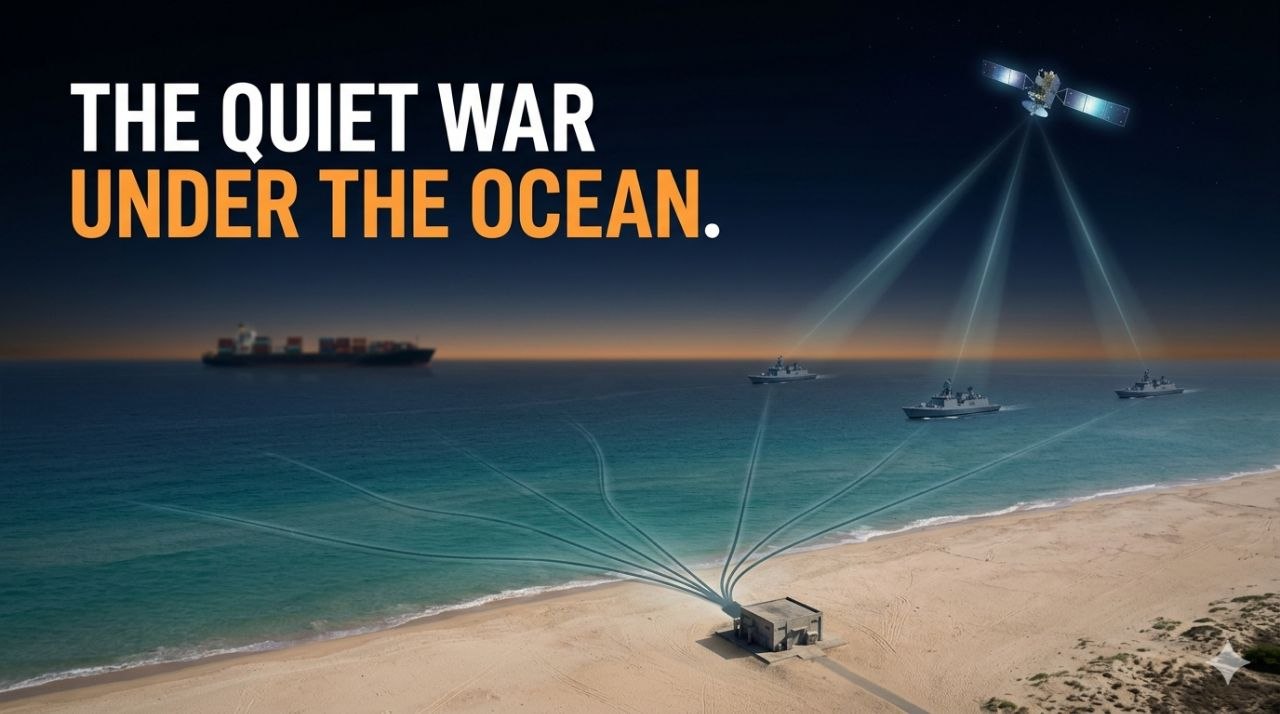
On the first day of the Spanish American War in 1898, one of the first operational acts of the United States Navy was not a naval engagement. It was the cutting of the Spanish telegraph cable connecting Cuba to Madrid. Sixteen years later, in August 1914, within hours of the British declaration of war on Germany, the Royal Navy cable ship Alert raised the German transatlantic cables from the floor of the English Channel and cut them. The act forced all subsequent German communications onto channels the British could read.
Cable cutting in war is older than radio. It is also back. And it is the strongest argument yet for why Indian defence communications can never run on the same wires that carry everyone else's WhatsApp.
Source: Small Wars Journal, Arizona State University
The Cables You Did Not Know You Depend On
Ninety five per cent of all international internet traffic in the world moves through submarine fibre optic cables strung across the ocean floor. Satellites carry the remaining five per cent. The cables are about the thickness of a garden hose. Every banking transaction, every cross border WhatsApp message, every cloud service runs on them.
An adversary that severs them does not have to break the encryption. The act of cutting is the operation. An adversary that cannot read your messages can still make sure you cannot send them.
Source: Wilson Center, Seabed Warfare Against Data Cables
The Global Pattern
Since 2023, at least 22 confirmed cable incidents have occurred in the Baltic Sea and around Taiwan. The US Senate's Critical Undersea Infrastructure Resilience Initiative Act, introduced in 2026, records the count.European and Taiwanese authorities have attributed several incidents to vessels with Chinese or Russian ownership, operating with opaque corporate structures and unexplained anchor behaviour.
The technique is simple. A merchant ship slows in the right area, lowers its anchor, and drags it across the seabed. The cable breaks. The ship continues on. The cost of cutting a cable is one ship and one anchor. The cost of repairing it is months of disrupted traffic.
The engineering is also in place. Lishui University in China filed a public patent in 2020 for what it called a dragging type submarine cable cutting device. A separate 2009 application from engineers at China's State Oceanic Administration outlined an anchor shaped cutter for the same purpose. HMN Technologies, formerly known as Huawei Marine Networks, is now one of the world's largest submarine cable construction firms. The state that builds the cables also patents the tools to cut them.
Source: US Senate Bill S.2222, 2026, Straight Arrow News on Chinese cable patents
The Indian Picture
India has 17 international subsea cables. They land in five coastal cities. Mumbai, Chennai, Cochin, Tuticorin, and Thiruvananthapuram.
Fifteen of those 17 cables arrive within a six kilometre stretch of a single Mumbai beach called Versova. The Broadband India Forum has written formal representations to the Department of Telecommunications about this concentration. Industry data shows that cable faults at Versova arrive monthly. The two foreign repair operators India contracts to fix them have average repair timelines of three to five months.
Monthly faults. Seasonal repairs. This is the operating condition of the network that carries the country's international civilian traffic. No matter how good the encryption, the network is brittle in ways no software can fix.
Source: BW Businessworld, March 2026
Why Defence Must Live On Its Own Network
This is the case that the case for sovereign defence communications is no longer a matter of preference. It is a matter of survival of the command chain.
Civilian internet was never designed for military resilience. It was designed for commercial reach and cost efficiency. Every property that makes it cheap and ubiquitous, the shared cables, the foreign repair contracts, the concentrated landing points, makes it unsuitable as the primary carrier of operational defence traffic. A network that can be degraded by one merchant ship dragging an anchor in the Arabian Sea is not a network on which a nation can fight.
India understood this early, and the work is well underway. GSAT-7 Rukmini, launched in 2013, is the dedicated communications satellite of the Indian Navy, supporting more than 50 ships and aircraft simultaneously across the Indian Ocean Region. GSAT-7A Angry Bird, launched in 2018, serves the Indian Air Force, linking ground radar stations, air bases, and airborne early warning aircraft. GSAT-6 covers remote and border areas where terrestrial networks do not reach. Replacements and additions are in the pipeline. GSAT-7R for the Navy. GSAT-7B, signed for in 2023 at a cost of three thousand one hundred crore rupees, will be the first dedicated military communications satellite for the Indian Army. GSAT-7C will be the IAF's second.
Source: GSAT-7 specifications, Indian Aerospace and Defence Bulletin on military communicationssatellites
This is the right architecture. The question is whether the pace and the funding match the threat.
The Grey Zone Has a New Front
The China-Pakistan information warfare playbook documented in our earlier piece on voice cloning works because it operates below the threshold of military response. Cable cutting works the same way. It does not require a missile. It does not require attribution that holds up in court. It only requires the patience to wait for an opportunity the entire shipping industry will help disguise.
The Versova vulnerability is a national infrastructure problem and an economic one. It cannot be allowed to become a defence one. Every additional rupee placed into GSAT-7B, GSAT-7C, the upgrade of the Defence Communication Network, and the broader sovereign defence stack is a rupee placed into the only kind of communications redundancy that survives an anchor dragged at three in the morning in the wrong piece of water.
The cables on the ocean floor will continue to carry the country's civilian internet. The soldiers, the ships, and the aircraft of the Indian armed forces must continue to ride a different network. The argument for accelerating that build was strong before. The cables being cut around the world this year make it inescapable.