Wi-Fi Through Walls: The RF Sensing Tech India Needs Before Pakistan Gets It
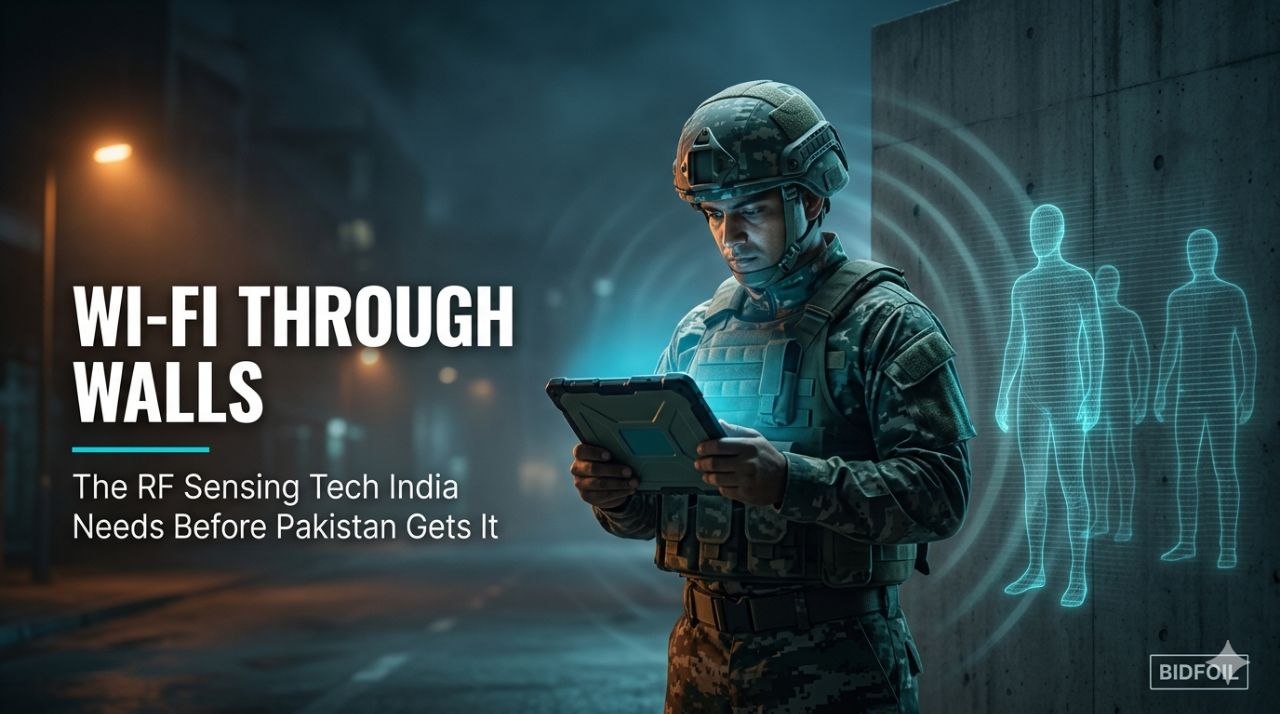
In January 2023, a team at Carnegie Mellon University published a paper that should have made headlines in every defence ministry in the world. Using only two ordinary Wi-Fi routers and a deep learning model, the researchers were able to reconstruct the full body posture of multiple people standing behind a wall. No camera. No radar. No special hardware. Just the same Wi-Fi signal that is bouncing around your living room right now. The paper is called DensePose From WiFi, and it is publicly available on arXiv.
This is not science fiction. The hardware is already inside crores of Indian homes. The only thing missing is the software. And that gap is closing fast.
What is RF sensing, in plain language?
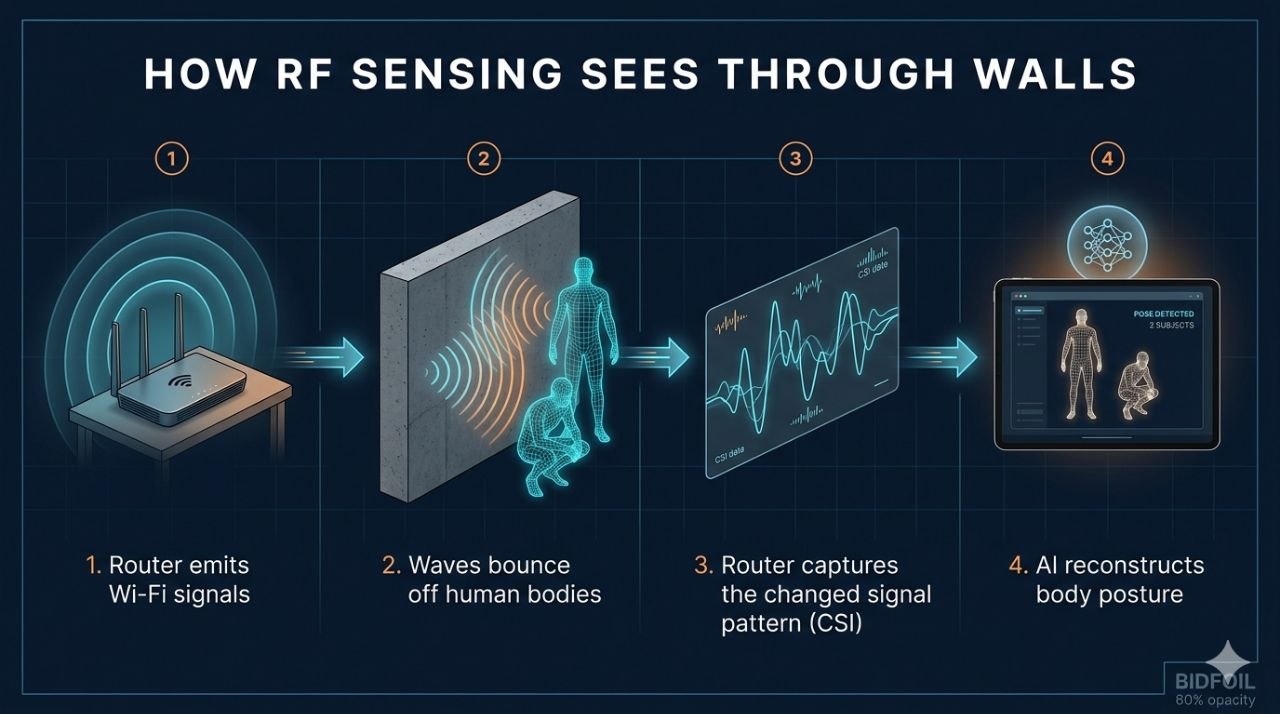
Every Wi-Fi router constantly sends out radio waves. These waves bounce off everything in the room, including your body. When you move, the pattern of those reflections changes in a very specific way. Routers already measure this pattern. It is called Channel State Information (CSI), and routers use it to maintain a clean signal with your phone or laptop.
The new idea is simple. If a router can already feel the room well enough to talk to your phone, it can also feel where you are standing, how you are moving, and even who you are. Comcast in the United States already ships a feature called Wi-Fi Motion on its newer routers. It uses exactly this trick to turn on lights when someone enters a room.
Researchers have pushed this much further. The CMU paper showed that Wi-Fi can map a human body in 3D through walls. A 2025 follow up study, called HuMi, showed that the same signals can identify which specific person is in the room, because every human body interacts with radio waves in a slightly different way. Bone density, height, gait, posture. All of it leaves a unique signature.
So we now have three steps, all proven in research labs:
- Step 1: Detect that someone is in the room.
- Step 2: Map their body posture through the wall.
- Step 3: Identify exactly who they are.
All three work in the dark. All three work through concrete. None of them need a camera.
Why this matters for the Indian battlefield
Think about the operational problems that have repeatedly hurt Indian forces in counter terror operations. A hostage situation in a building in Srinagar. A militant hiding inside a house in a Kashmir village during a cordon and search operation. A terrorist holed up in a Mumbai hotel room. In every single case, the most dangerous question is the same. How many people are inside, and where are they standing?
Today, that question is answered with great risk to soldiers' lives. A team has to physically breach the door without knowing what is on the other side. RF sensing changes that completely. A soldier holding a small device outside the wall can see, in real time, how many human figures are inside, whether they are standing or lying down, and roughly where their hands are.
This is exactly why DRDO has already built one such system. It is called Divyachakshu, which means Divine Eye. Developed at DRDO's Electronics and Radar Development Establishment (LRDE) in Bengaluru, it is a through barrier imaging radar designed exactly for hostage rescue and CQB (close quarter battle) situations. Reports place the cost at around ₹35 lakh per unit, compared to over ₹2 crore for foreign equivalents. DRDO has indicated it will be offered to the Indian Army, BSF and paramilitary forces.
Divyachakshu uses dedicated radar hardware. The Wi-Fi research goes one step further. It suggests you may not even need that. Any room with a router could, in theory, become a sensor.
The Pakistan angle nobody is talking about
Pakistan's military has invested heavily in Chinese electronic warfare and surveillance technology over the last decade. China is one of the world leaders in Wi-Fi sensing research, with multiple papers from Tsinghua University and other institutions on exactly this subject. It is very reasonable to assume that the People's Liberation Army has been studying military applications of CSI based sensing for years, and that some of this knowledge will, in time, reach Rawalpindi.
The threat is twofold:
- Offensive use: A hostile actor near an Indian Army cantonment, a forward base, or a sensitive building could potentially use cheap, off the shelf Wi-Fi equipment to count people inside, track movement patterns, and identify routines, all without setting foot inside the perimeter.
- Defensive blindness: If we do not understand this technology, we cannot defend against it. Standard counter surveillance sweeps look for hidden cameras and microphones. They do not look for a neighbour's Wi-Fi router that has been quietly mapping your movements for six months.
The good news is that India is not starting from zero. Beyond Divyachakshu, DRDO has also developed the DHRUTI RWR (DR118), a radar warning receiver already in service on the Su-30MKI. It is built to detect, classify and track RF emitters in real time. The underlying expertise to do passive RF sensing exists inside the Indian defence ecosystem. What is needed now is to push it into the dismounted soldier's hands.
What India should be doing now
Three things, in order of urgency.
1. Scale Divyachakshu and similar through wall sensors
The hostage rescue and CQB use case is already proven. The system is indigenous and is much cheaper than imported alternatives. It should be widely issued to NSG, Para SF, Rashtriya Rifles units in Kashmir, and CRPF anti Naxal formations. Every cordon and search team should have one.
2. Fund Indian research on Wi-Fi and 5G based sensing
The CMU work is already open source. Indian institutions like IIT Madras, IIT Bombay, IISc Bengaluru, and DRDO's CAIR are well placed to build on it. The cost of entry is low. A few routers, a GPU server, and graduate students. The military payoff is high.
3. Build counter RF sensing doctrine
Sensitive buildings such as operations rooms, intelligence offices, war rooms, and residences of senior commanders need to be evaluated for RF leakage. Shielding, signal scrambling and active counter sensing techniques need to become part of standard physical security practice. This is the modern equivalent of sweeping a room for bugs.
The bottom line
For most of history, radio waves were treated as dumb pipes that simply carried information from one device to another. We are now realising that those same waves have been painting a detailed picture of the physical world all along. We just did not know how to read it. Compute is now cheap enough, and AI good enough, that we can.
RF sensing will sit alongside cameras, radar and infrared as one of the core sensing layers of the next decade of warfare. It works in the dark. It works through walls. It works in bad weather. It works on hardware that already exists in every home, every office and every base in the country.
India has a real lead on the hardware side, thanks to Divyachakshu and DHRUTI. The question is whether we can move fast enough on the software, the doctrine and the field deployment, before the same physics shows up on the other side of the Line of Control.