Where Does AI Fit in the Year of Networking and Data Centricity?
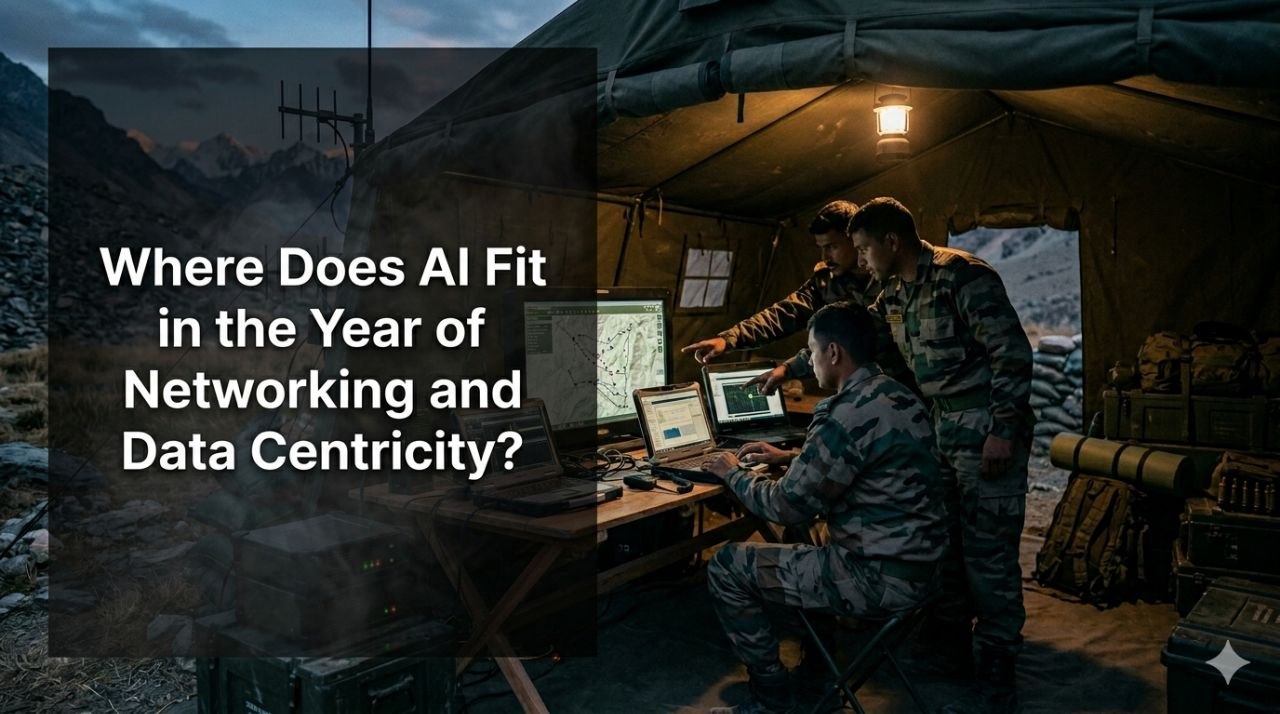
On 1 January 2026, General Upendra Dwivedi, the Chief of the Army Staff, declared the year ahead as the Indian Army's Year of Networking and Data Centricity. The phrasing was deliberate. It followed 2024–25, marked as the Year of Technology Absorption, and it pointedly did not say Year of Artificial Intelligence. For a force that has spent the last three years signalling its appetite for AI through the Defence AI Council, the iDEX programme and DRDO's Centre for Artificial Intelligence and Robotics (CAIR), the choice of words is worth pausing on.
The lesson from Operation Sindoor in May 2025 was not that India lacked AI. It was that India lacked a mature data and networking spine on which AI could meaningfully sit. Between 7 and 10 May, the integrated air-defence shield neutralised hundreds of incoming drones and missiles across the western front not because of a single clever algorithm, but because the Akashteer air-defence control and reporting system — an indigenous BEL platform — stitched Army radars, IAF sensors and ground-based weapons into one picture. That is networking and data centricity. The targeting intelligence that allowed nine sites in Pakistan and Pakistan-occupied Kashmir to be struck in 23 minutes came from sensor and signals fusion across NTRO, ISRO and service-level ISR. That, again, is networking and data centricity. AI played a real role at the edges — onboard loitering munitions like the JM-1 and ALS-50, in counter-UAS classification, in EW pattern recognition. But it played that role because the layer beneath it was good enough to feed it.
The hierarchy the theme implies
The Army's 2026 theme reflects a hierarchy that defence technologists understand but civilian discourse often inverts: connectivity, then data, then analytics, then AI, then autonomy. Skip a layer and the layer above collapses.
A platform-centric force, in the Army's own framing, is one where a scout's contact must be radioed up a chain, repeated, written down and pushed back down to a gun position or air-support requestor. A data-centric force is one where the same contact lights up simultaneously on every screen that needs it — artillery fire-control, infantry battalion HQ, the corps operations cell, an attack helicopter's mission computer. AI does not deliver this. Networking and a common data fabric do. AI uses the fabric.
Read this way, 2026 is a foundational year. Without it, AI in the Indian military will continue to live as scattered pilots — a CAIR project here, a vendor demonstration there — without ever cohering into the kind of capability that other militaries have begun fielding.
Where AI actually fits in 2026
If networking and data are the spine, AI fits at three specific joints. Each maps to work already in motion within the Indian defence ecosystem.
1. Counter-UAS and the saturation problem
This is the most operationally urgent application. Pakistan's retaliatory Operation Bunyan al-Marsus reportedly launched 300–400 drones in waves — including Turkish Bayraktar TB2s and Chinese CH-4 and Wing Loong II platforms — on the night of 7–8 May 2025. Saturation attacks of that scale cannot be handled by human operators in the loop alone. The Indian Army's Saksham counter-UAS grid, approved in 2025, is the institutional answer: an integration of radars, RF sensors, EO/IR cameras and effectors, with BEL and DRDO laboratories as the principal technology providers. AI sits inside Saksham as the classification and prioritisation layer — separating a quadcopter from a bird, a decoy from a warhead-carrier, a lone drone from a coordinated swarm.
2. Loitering munitions and the autonomous terminal leg
The JM-1 from Johnnette Technologies and the ALS-50 from Tata Advanced Systems Limited entered combat use during Operation Sindoor. Their utility lies precisely in the moments when the network fails — when GPS is jammed, when the data link drops, when the operator loses contact. Onboard AI, running on small edge processors inside the munition itself, completes the terminal attack leg. This is the same architectural pattern that Russia's Lancet (built on the Nvidia Jetson platform) and Ukraine's Saker Scout drones have demonstrated over the past two years. The relevant paradigm here is edge inference, not cloud AI — and it is where indigenous compute and indigenous models matter most.
3. Decision support inside the staff
The third and most underrated joint is staff work. A brigade operations cell handles a relentless flow of situation reports, logistics indents, casualty updates, weather, intelligence summaries and orders — most of it text. Air-gapped large language models, served on indigenous compute within formation networks, can compress the staff officer's reading load: drafting routine correspondence, summarising long signals, querying a unit's own knowledge base. CENJOWS commentary has flagged office work as the lowest-hanging fruit for the Indian Army. It needs no new sensors and no new networks beyond what already exists. It is implementable in 2026 itself.
The hard problems 2026 will expose
A focus on networking and data also surfaces problems that AI hype has tended to obscure.
The first is data hygiene. Indian Army data lives in silos — war diaries, intelligence summaries, ACRs, equipment logs — much of it on paper, much of it inconsistently formatted. Models trained on dirty or sparse data hallucinate. The Army's emphasis on data centricity is, in part, an acknowledgement that foundational data-engineering work must precede operational AI.
The second is sovereignty. Operation Sindoor reportedly saw the IAF jam Pakistan's Chinese-supplied HQ-9 air-defence systems and complete a strike package in 23 minutes. That capability depended on indigenous EW and indigenous data pipelines. AI tools that depend on foreign cloud infrastructure are a strategic vulnerability of the same kind — one geopolitical squeeze, and a unit's analytical capability evaporates. The 2026 theme implicitly favours indigenous, on-premises and air-gapped deployments. Open-weight model families, quantised and served locally on BEL or DRDO-supplied compute, fit this constraint. Closed cloud APIs do not.
The third is the human-in-the-loop question. Reporting from Gaza and Ukraine has shown what happens when human review collapses to seconds per recommendation. The Indian Army's doctrinal posture has so far been conservative on autonomy. 2026 is the moment to write down, in doctrine, where the human stays in the loop and where they do not — before the technology arrives and forces an answer by default.
The takeaway
2026 is not a year about AI. It is a year about building the conditions under which AI in the Indian Armed Forces can stop being a collection of demonstrations and start being a capability. Networking is the pipe. Data is the fuel. AI is the engine — and it runs only as well as the pipe and the fuel allow.
The militaries that have moved fastest on AI — Ukraine's Brave1 ecosystem, the US Maven Smart System, Israel's integrated air-defence command — did not get there by buying AI. They got there by first solving the networking and data problems that make AI useful. The Indian Army's New Year message reads, in this light, less like a slogan and more like an acknowledgement that the foundations come first.