What an Indian Soldier's AI Toolkit Should Look Like in 2027
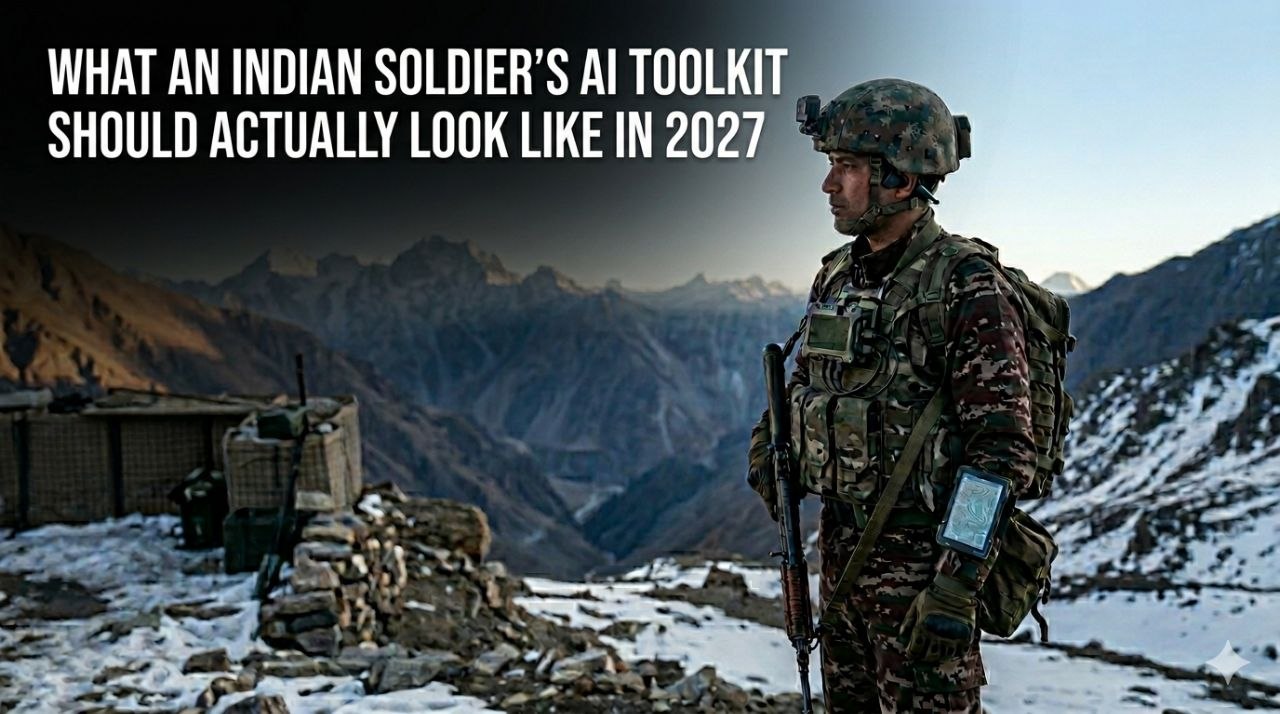
In August 2022, then-Defence Minister Rajnath Singh handed over the Futuristic Infantry Soldier as a System (F-INSAS) kit to the Indian Army at a public ceremony in Delhi. The package centred on the AK-203 rifle, a ballistic helmet, an upgraded bulletproof jacket, and a hand-held tactical computer concept. Three and a half years later, the integrated network and battlefield management layer that was meant to make F-INSAS a "system" rather than a collection of items remains a work in progress — a fact acknowledged in defence commentary going back to the original split of F-INSAS into two parallel tracks in 2015.
The hardware question for the Indian infantry soldier is largely solved. The software question is not. By 2027, the deployment of edge AI on commercially available hardware will have made many capabilities — once exotic — cheap and field-ready. The question is whether the Indian Army will have an integration plan to put them on a soldier's webbing.
Start with what the soldier actually needs
A useful constraint: any AI capability that adds more than 200 grams of weight, requires more than three hours of additional battery life per day, or demands cloud connectivity is not a soldier's tool. It is a headquarters tool. The history of F-INSAS is partly a history of ignoring this constraint — adding sensors, sights, and computers without solving the power and weight budget.
Working from that constraint backwards, the genuinely useful AI capabilities for an Indian infantryman in 2027 fall into five buckets:
- Threat detection at the helmet: real-time identification of drones, vehicles, and human silhouettes from a low-resolution camera or thermal sensor.
- Voice-driven situation reporting: hands-free dictation of contact reports in Hindi, English, or regional languages, with automatic translation to the section commander's preferred format.
- Local language and dialect translation: offline translation between Mandarin, Tibetan dialects, Pashto, and Indian languages — relevant on both LAC and LoC.
- Terrain and route assistance: AI overlays on existing topographic maps that warn of dead ground, likely ambush points, and degraded GPS regions.
- Casualty triage and self-aid prompts: voice-guided medical response when a buddy goes down, drawing on standard combat lifesaver protocols.
None of these require a breakthrough. All are achievable on hardware available today.
The hardware reality of 2027
The shift that makes a soldier's AI toolkit feasible is the maturation of edge AI silicon. NVIDIA's Jetson Orin Nano and Orin NX modules already deliver the inference performance needed to run quantised vision and language models in a package small enough to fit in a chest rig. Qualcomm's automotive and robotics-grade chips offer similar profiles at lower power. Indian system integrators including Tonbo Imaging, Paras Defence, and a generation of iDEX-funded start-ups have demonstrated thermal imaging, sensor fusion, and edge inference at the prototype level.
By 2027, a credible soldier kit could include:
- A helmet-mounted thermal-fused camera streaming to a chest-worn compute module running a quantised vision model. Power draw under 8 watts. Inference latency under 100 milliseconds.
- A bone-conduction headset with always-on voice activity detection running locally — no audio leaves the soldier's body unless explicitly transmitted.
- A 6-inch sunlight-readable display on the forearm, mirroring critical alerts from the section commander's tablet, with offline maps cached for the operational area.
- A power pack rated for 12 hours of continuous use, charged via a body-worn solar panel or a vehicle hookup at the section's pickup point.
None of this is speculative. All of it has been demonstrated, in pieces, by Indian and allied firms. The integration is what is missing.
The data problem nobody discusses
An AI model that classifies vehicles is only as good as its training data. The Indian Army has access to terrain, vehicle, and uniform imagery that no foreign vendor can replicate — operational footage from the LAC, LoC, and counter-insurgency theatres, accumulated over decades. None of it is systematically curated for AI training.
A soldier's AI toolkit cannot be built on Western datasets. A vehicle classifier trained on NATO photography will misidentify a Chinese ZBD-04 against a snow background. A face-detection model trained on Western faces will perform poorly in low light against South Asian and East Asian features. A speech model trained on standard Hindi will struggle with the dialects spoken in Ladakh, Sikkim, and the Northeast.
The implication is structural: before the Army procures soldier AI hardware, it needs a data strategy. That means a designated authority — most plausibly under the Army Design Bureau working with DRDO's Centre for Artificial Intelligence and Robotics (CAIR) — to systematically capture, label, and curate operational imagery and audio for AI training, with strict rules on classification and access. Without this, every Indian start-up building soldier AI will be training on synthetic or scraped data, and the resulting models will fail in the field.
What can ship by 2027 — realistically
Three capabilities are achievable in production quantities by late 2027 if the Army moves now:
1. Drone detection and classification at the squad level
Acoustic and visual drone detection using cheap microphones and a low-resolution camera, with on-device classification of common Chinese and Pakistani UAS types. Output: a vibration alert to the soldier and a coordinate push to the section commander. Indian start-ups have already demonstrated the underlying technology; what is needed is a standardised hardware specification and a procurement order.
2. Offline language translation for forward formations
A 4–7 billion parameter quantised language model running on a chest-worn compute module, supporting Mandarin, Tibetan, Pashto, Punjabi, and Urdu both ways with English and Hindi. No cloud dependency. Useful for prisoner interrogation, intercepted radio chatter, and document exploitation. The technology exists; the operational fielding does not.
3. Augmented-reality navigation in degraded GPS environments
An AI-assisted dead reckoning system that fuses inertial sensors, visual landmarks from the helmet camera, and the IRNSS/NavIC signal where available. Critical in Ladakh's high-altitude valleys where GPS is unreliable and Chinese jamming is documented. Bharat Electronics Limited and CAIR have the building blocks.
The institutional change that has to happen
None of this works without a buyer who understands software. The Indian Army's procurement system was designed for capital platforms with twenty-year service lives, not for software that needs to be retrained every six months as new threats emerge. A drone classifier built in 2025 against a known Chinese UAS fleet will be obsolete by 2027 if it cannot be updated.
The fix is not technological. It is a procurement-vehicle change: a long-term framework agreement under iDEX or the new Defence Acquisition Procedure software clauses, with performance milestones tied to operational testing, not paper specifications. The Army's recent willingness to fund start-ups directly through the Army Design Bureau and the iDEX-Prime track is the right direction. It needs to scale.
The takeaway
The fantasy version of a 2027 soldier toolkit involves exoskeletons and battlefield robots. The realistic version is more modest and far more achievable: a helmet camera that flags drones, an earpiece that translates Mandarin, a forearm display that shows the section's positions, and a power pack that lasts a day. All of this can be built in India, by Indian firms, on Indian-collected data — if the Army decides that integration, not hardware, is the actual deliverable.
F-INSAS in 2022 handed soldiers a rifle, a helmet, and a vest. F-INSAS in 2027 should hand them software that learns. The gap between those two visions is not a technology gap. It is an institutional one.