Ukraine's AI Border Playbook: Lessons for Indian Defence

Ukrainian border guards used Clearview AI to identify over 10,000 people at checkpoints, including 50 linked to illegal child transfers. The operation combined facial recognition, drone imagery, and real‑time decision software, showing how AI can speed border policing from days to minutes. The system also logged each interaction, creating an audit trail that helped investigators trace networks of smugglers and human‑trafficking rings.
What Ukraine Built
Ukraine’s AI stack grew from volunteer tools into a wartime system covering six areas, from autonomy to data fusion. Three elements are most relevant to Indian borders, but the architecture also includes predictive threat modelling, automated de‑confliction of air assets, and a resilient communications layer that switches between satellite, cellular and mesh networks.
- Drone‑fed AI fusion. UAV feeds are processed by computer‑vision models that flag vehicles, weapons and people on a shared map. The models run on edge GPUs, sending only annotated metadata to the command centre, which reduces bandwidth usage by up to 90 %.
- Facial recognition at checkpoints. Clearview‑style searches vet travelers and reunite families, running hundreds of thousands of queries per day. The system cross‑references watch‑lists, biometric passports and open‑source images, and it automatically raises alerts when a match exceeds a confidence threshold.
- GPS‑denied navigation. Vision‑based AI enables drones to operate despite jamming, a capability needed for Indian border drones that must patrol rugged terrain where adversaries frequently disrupt GNSS signals.
The key is institutional: small, cross‑functional teams iterate fast, push updates directly to the field, and maintain a continuous feedback loop with end‑users. Documentation is kept lightweight, and version control is handled through a cloud‑based repository that can be accessed from forward operating bases.
India’s Current Position
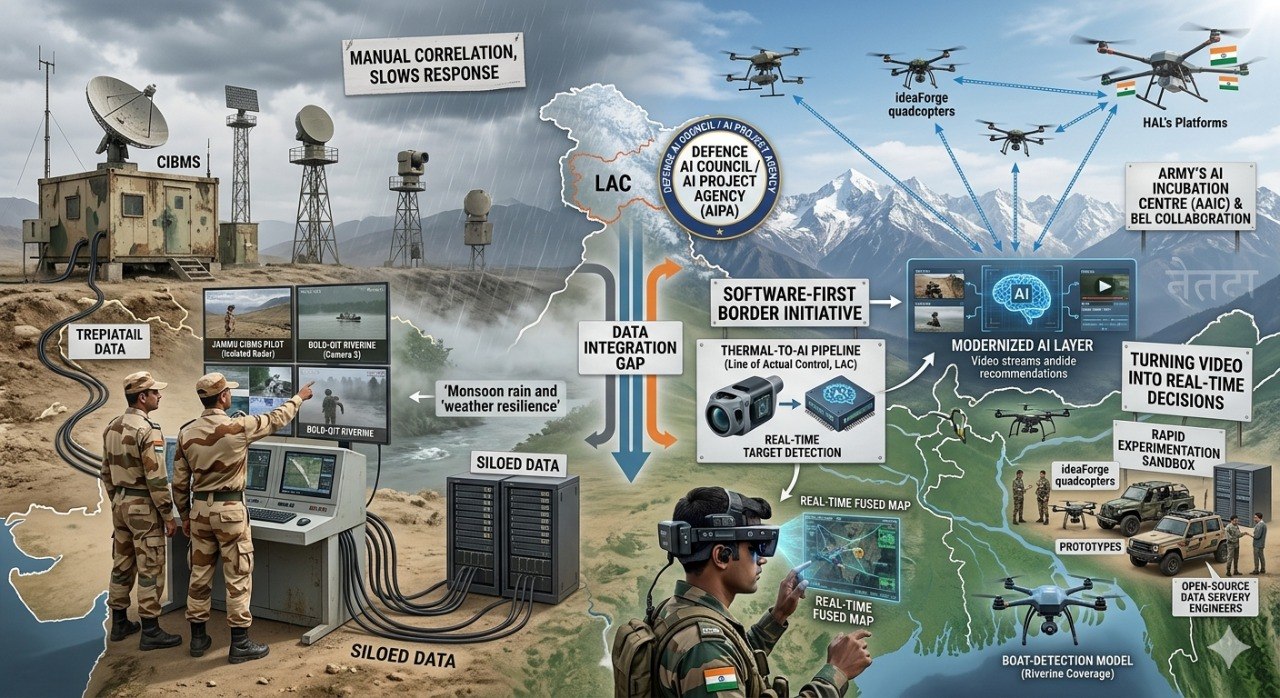
India already has many components. CIBMS pilots cover parts of the Jammu sector and the Indo‑Bangladesh border (BOLD‑QIT project). Gaps remain in sensor integration, riverine coverage, and weather resilience. Existing radar and thermal stations often operate in silos, requiring manual correlation that slows response times.
On the AI side, DRDO’s CAIR lab, the Defence AI Council, and the AI Project Agency coordinate efforts. Recent defence showcases featured 75 AI products, and the Army’s AI Incubation Centre works with BEL to industrialise outputs. Drones such as ideaForge quadcopters and HAL’s larger platforms are fielded, but the AI layer that turns video into decisions is still immature. Most video streams are stored for later analysis rather than being processed in real time.
To bridge the gap, the Ministry of Defence has launched a “Software‑First Border Initiative” that funds joint‑venture prototypes, mandates open‑source data standards, and creates a sandbox for rapid experimentation. Early pilots include a thermal‑camera‑to‑AI pipeline for the Line of Actual Control and a boat‑detection model for the Ganges‑Brahmaputra delta.
Five Lessons for India
1. Make the common operating picture the product
Focus on software that fuses thermal feeds, drone imagery, tip‑offs and signals into one map, rather than treating sensors as isolated capital projects. A unified dashboard should allow a border‑patrol officer to click a hotspot and instantly see the raw video, AI‑generated annotations, and historical activity for that location.
2. Push AI to the edge
Run vision models on drones or cameras so only metadata needs bandwidth, ensuring functionality in low‑connectivity zones. Edge inference also reduces latency; a UAV can flag a suspicious convoy within seconds, giving ground teams enough time to intercept before the target crosses the line.
3. Build a domestic face‑match stack
Develop Indian‑sourced datasets and infrastructure, with strict retention and audit rules, to avoid reliance on foreign vendors. The stack should support multi‑modal biometrics—face, iris and fingerprint—so that it remains effective even when one modality is obscured by weather or camouflage.
4. Industrialise the volunteer model
Leverage defence‑tech startups through iDEX, giving vetted teams secure access to field units for rapid model training on local terrain. Incentivise open‑source contributions by offering fast‑track procurement for algorithms that meet defined performance and security benchmarks.
5. Plan for adversary AI
Require resilience against spoofed signatures, GPS denial, and decoy swarms; embed red‑team testing and secure update pipelines in CIBMS Phase II. Simulated adversarial attacks should be run quarterly to validate that the AI stack can detect deep‑fake videos, adversarial patches on uniforms, and electronic‑warfare attempts.
Example Use Cases for the Indian Armed Forces
- Mountain‑pass monitoring (Jammu & Kashmir). Fixed thermal cameras mounted on ridge‑top outposts feed low‑resolution frames to an edge‑AI module that classifies human silhouettes versus wildlife. When a group larger than three is detected moving at a speed consistent with foot patrols, the system automatically alerts the nearest infantry brigade, providing GPS coordinates and a short video clip.
- Riverine interdiction (Indo‑Bangladesh border). Tethered aerostats equipped with 4K optical and infrared sensors scan the Brahmaputra delta. An AI model distinguishes between fishing boats, cargo barges and makeshift rafts used by smugglers. If a raft carries more than two adults and a child, the system generates a priority alert that is routed to river‑patrol units and the Coast Guard.
- High‑speed vehicle detection on National Highway 44. Road‑side LiDAR units feed point‑cloud data into a convolutional network that identifies fast‑moving trucks attempting to breach checkpoint queues. The AI flags anomalies such as vehicles travelling in the wrong lane or with altered license plates, prompting a rapid‑response team to conduct a stop‑check.
- Air‑space de‑confliction over the Western Frontier. AI‑enabled radar fusion correlates data from Indian Air Force AWACS, HAL‑driven UAVs and ground‑based radars to produce a 3‑D air picture. When an unidentified low‑altitude drone penetrates a restricted corridor, the system recommends a counter‑UAV launch and provides a predicted flight path.
- Human‑trafficking detection at railway stations. CCTV feeds from major stations in West Bengal are processed by a facial‑recognition pipeline that matches faces against a curated watch‑list of known traffickers. When a match occurs, the system sends a discreet alert to the Railway Protection Force, including a time‑stamped video snippet and the suspect’s last known travel itinerary.
Riverine Test Case
The Indo‑Bangladesh river border mirrors Ukraine’s forested front. BOLD‑QIT proved sensor grids work; the next step is AI on cameras and tethered aerostats to classify boats, livestock and humans, sending only verified alerts to quick‑reaction teams. A pilot program will integrate a lightweight YOLO‑v8 model on the aerostat’s onboard processor, reducing the uplink data rate from 10 Mbps to under 200 kbps per hour while maintaining 92 % detection accuracy.
What to Watch
Track how quickly the Defence AI Project Agency moves from demos to standard operating procedures. Funding remains modest, but the shift from hardware‑first to software‑first procurement will determine future effectiveness. Key indicators include the number of field‑tested AI models deployed, the average time from data collection to model rollout, and the proportion of border incidents resolved with AI‑generated alerts.