No More Radio Silence: AI and the Indian Army's Comms Gaps
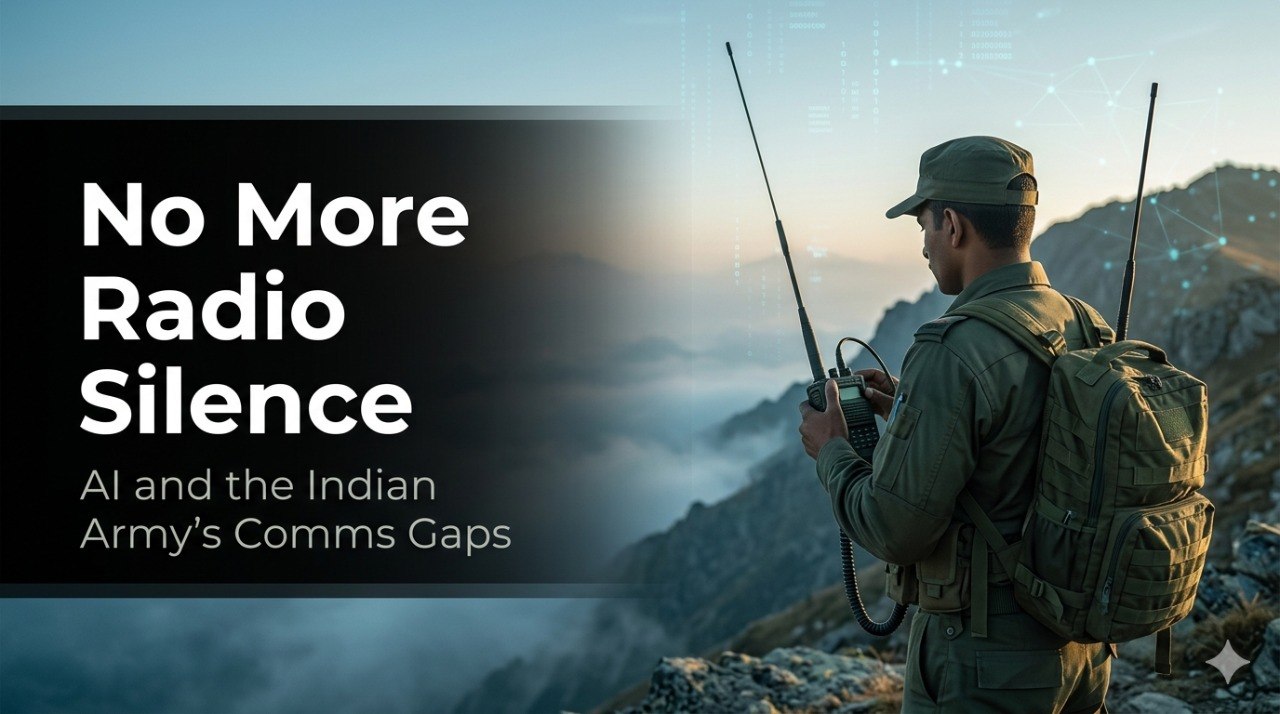
On 28 October 2025, the Indian Army signed its first contract for indigenous Software Defined Radios, developed by DRDO and built by Bharat Electronics Limited, with high data rates and Mobile Ad hoc Network (MANET) capabilities (ANI). Three weeks earlier, DRDO had released the Indian Radio Software Architecture (IRSA) standard 1.0, the country's first national software standard for military radios.
The hardware is only half the story. The real bottleneck is everything that happens between the radios: crowded spectrum, terrain that blocks signals, jamming, and signallers who are doing too many things at once. This is where AI stops being a buzzword and starts being useful.
The communication gaps the Army actually has
Three problems keep showing up.
1. Terrain that swallows signals
The same mountains that help India defend its borders also block VHF radio. A patrol on the wrong side of a ridge in Eastern Ladakh, or a column moving through dense forest in the North East, often loses contact with its parent unit. Relay stations help, but every relay is one more node that has to be manned, powered and protected.
2. Crowded spectrum
A modern Indian armoured brigade today operates hundreds of radios, drones, ground sensors and electronic warfare emitters in overlapping bands. The old Army Radio Engineering Network (AREN), fielded in 1987, was built when a battalion had perhaps two dozen sets. Today's airwaves are dense enough that friendly interference alone can degrade a net.
3. Active jamming
Both the Pakistan Army and the PLA field serious electronic warfare units. The war in Ukraine has shown that any radio which transmits in a predictable way gets located, and anything that gets located gets shelled. Doctrine has caught up with this reality, but doctrine alone does not stop a directional jammer.
Where AI actually earns its place
The useful applications are small, focused models running at the edge, on the radio itself or on a soldier's tablet. Each does one thing reliably.
Cognitive radio for spectrum management
This is the easiest win. A smart layer on top of a Software Defined Radio listens to the airwaves around it, figures out which frequencies are clear, which are busy with friendly traffic and which are being jammed, and then hops to a better one without the operator touching anything.
The IRSA standard makes this kind of intelligence portable across radios from different vendors (Army Technology). Without that common architecture, every smart feature would be locked to one company's box.
AI-driven mesh routing for MANETs
A Mobile Ad hoc Network is meant to heal itself. If one node drops, the others should reroute around it. In practice, the routing built into commercial MANET stacks was designed for civilian use and falls apart when nodes are moving fast across broken ground with patchy line of sight.
Reinforcement learning models, trained on terrain and movement data, can keep links alive much better. This matters most for the kind of dispersed, mobile units the Army is now building around, such as the new Integrated Battle Groups and small special operations teams working far ahead of the front line.
Voice-to-data compression and structured reports
A contact report read out over voice takes around fifteen seconds and is easy to mishear. The same report, structured by an on-device model that recognises the standard SITREP format, becomes a few hundred bytes of encrypted data that can be pushed through a weak link in a fraction of a second. The signaller still speaks. The radio does the rest.
Anomaly detection for electronic warfare
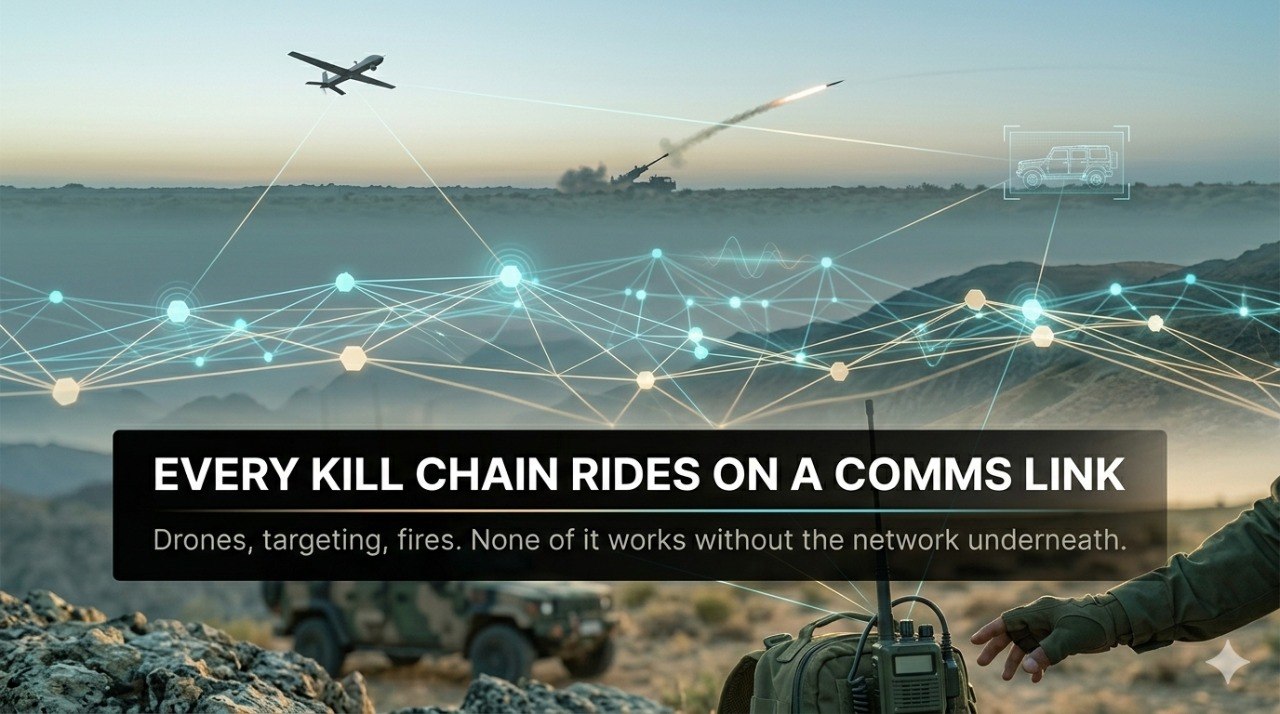
An AI model watching the spectrum can flag a new emitter, a jammer turning on, or an unusual pattern of nodes going silent, well before a human signal officer reading paper logs would notice. Tied into the Tactical C3I picture, this becomes early warning for an incoming strike, not just a comms problem.
The hard parts nobody likes to talk about
Training data is the binding constraint
A cognitive radio that has only ever heard the spectrum around a Mahajan firing range will behave unpredictably the first time it is taken to Tawang. Building Indian-specific datasets, covering local terrain, weather, friendly emitter signatures and likely adversary jamming patterns, is unglamorous work. The Ministry of Defence's stated AI Stack initiative, meant to provide standard datasets and simulators, is the right idea. Whether it actually delivers usable artefacts at the pace the Army needs is the open question.
Edge compute has weight, heat and battery costs
A useful AI model running on every man-pack radio means more power draw, more heat, and one more thing that can break. The trade-off against simply carrying a second battery is real, and it has to be made unit by unit.
Autonomy thresholds
A cognitive radio that quietly switches frequencies is uncontroversial. A model that decides on its own to stop transmitting because it thinks the unit is being located by direction-finding is a different matter. That is a tactical decision. Where the human stays in the loop, and where the machine is allowed to act on its own, is a doctrinal question the Army will have to answer formally rather than letting it emerge by accident from procurement choices.
The pieces are mostly already in place
The path forward is not exotic. Most of the building blocks are in hand or on contract.
- Indigenous Software Defined Radios from BEL (The Week)
- The IRSA waveform standard from DRDO
- The new BEL Tactical Communication System replacing AREN (Indian Masterminds)
- Ongoing iDEX challenges in autonomous communications
- A growing Indian private ecosystem of military-grade AI firms
What the next five years should look like
What the Army needs, roughly in this order:
- Serious investment in waveform and spectrum datasets that actually represent Indian theatres.
- Field trials of cognitive routing on real exercises, not vendor labs.
- A hardened standard for on-device AI that any approved vendor can target.
- A clear doctrinal note on what AI in the comms loop is and is not allowed to decide.
None of this is a moonshot. All of it needs steady engineering work and the patience to let the first generation fail honestly so the second one can be built right.
The takeaway
The headline-grabbing uses of military AI are the lethal ones: autonomous drones, target recognition, decision support for fires. The boring use, keeping a section commander in voice and data contact with his company HQ when the weather is bad, the spectrum is contested, and the enemy is jamming, is the one that decides whether the lethal uses matter at all.
The Indian Army's communications modernisation has finally reached the point where indigenous hardware is arriving in usable numbers. The next decade is about making that hardware smart enough to survive contact with a real battlefield. That is no longer a procurement problem. It is a software problem, and India, of all countries, ought to be able to solve it.